

Health, Safety, and Environment (HSE) training is essential for preparing employees to identify workplace hazards and respond correctly to safety-critical situations. However, traditional training methods often focus on theory, with limited opportunities for employees to practise what they have learned.
This is where VR training can make a difference. Virtual Reality creates realistic workplace environments where employees can practise safety procedures and experience different scenarios without being exposed to real-world risks.
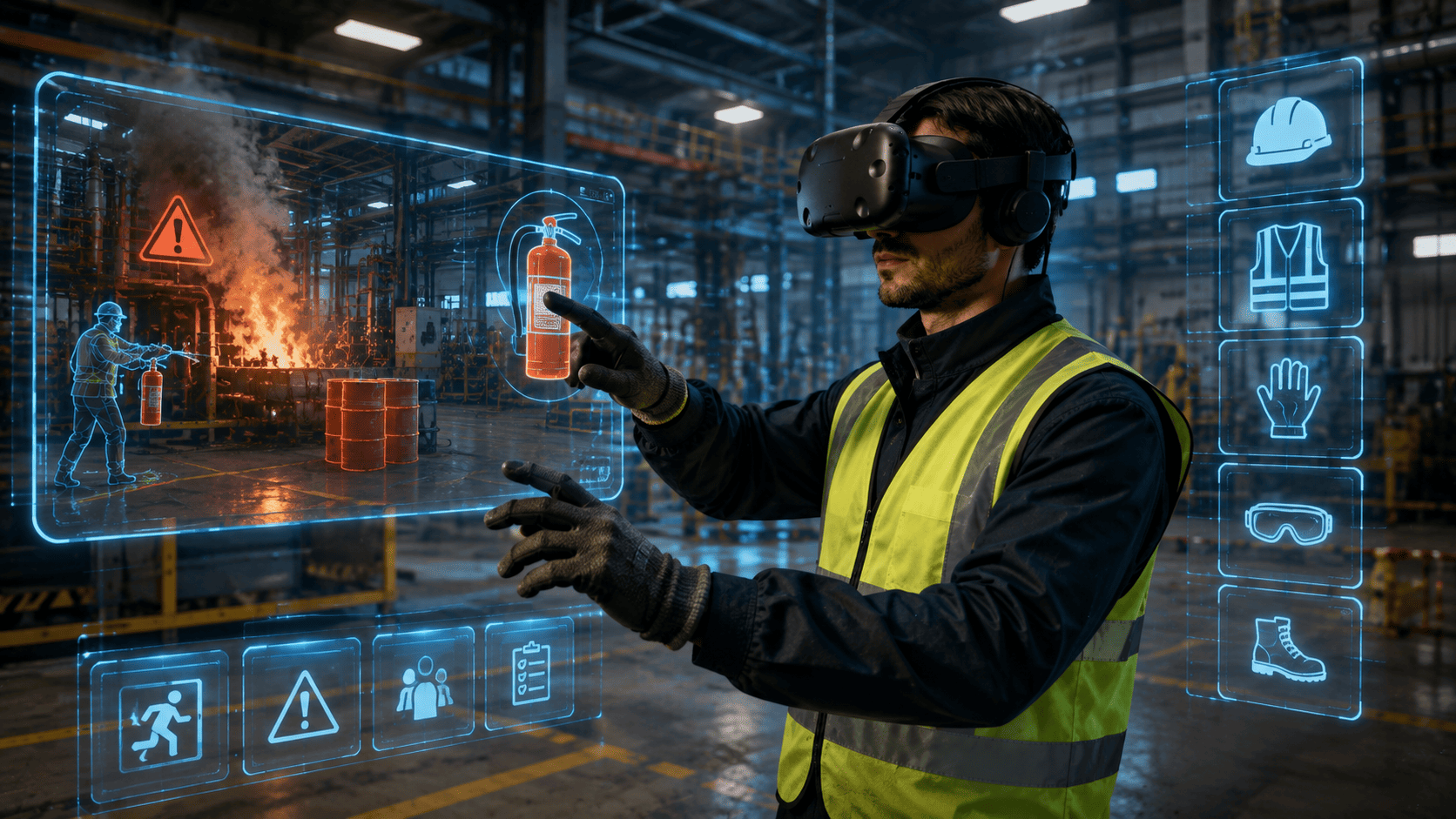
How VR Training Supports HSE
VR can simulate environments such as manufacturing facilities, construction sites, warehouses, mines, and oil and gas facilities. Employees can enter these virtual environments and practise tasks in a controlled setting.
For example, VR training can simulate fire emergencies, evacuation procedures, hazard identification, PPE usage, Lockout/Tagout (LOTO), equipment handling, confined-space entry, and working-at-height scenarios. Employees can make decisions and practise the correct response without creating an actual workplace hazard.
Practising Before Facing Real-World Risks
One of the biggest advantages of VR for workplace safety is the ability to practise high-risk situations safely. Employees can repeat procedures, identify mistakes, and become familiar with the correct sequence of actions before performing the task in a real environment.
This is particularly useful for activities where mistakes can have serious consequences. Instead of simply explaining what employees should do, VR allows them to actively practise it.
Making Safety Training More Engaging
VR training turns employees from passive participants into active participants. They can explore an environment, identify hazards, operate equipment, and respond to simulated emergencies.
This practical approach can make safety concepts easier to understand and give employees greater familiarity with the procedures they are expected to follow.
Measuring Training Performance
VR training can also include performance tracking. Organizations can monitor actions, identify incorrect decisions, and assess how employees perform during simulated scenarios.
These insights can help trainers identify areas that require additional practice and support a more structured approach to workplace safety training.
The Future of VR in HSE
As immersive technology continues to develop, VR training is becoming an increasingly useful addition to modern HSE programs. It provides organizations with a way to simulate realistic situations that may be difficult, expensive, or unsafe to recreate physically.
The goal is simple: give employees an opportunity to practise safety before they face the real situation.
Conclusion
VR training can complement traditional HSE programs by bringing practical, immersive simulation into workplace safety training. From emergency response and hazard identification to equipment handling and high-risk procedures, VR can help organizations create more practical training experiences.
At DevDen, we develop customized VR training solutions for workplace safety, industrial processes, equipment handling, and HSE requirements.
Looking to develop a VR training solution for your organization? Contact DevDen to discuss your requirements.
