

Manufacturing environments are becoming increasingly complex, with employees expected to work with advanced machinery, follow detailed production procedures and maintain strict workplace safety standards. Preparing workers for these responsibilities requires more than theoretical knowledge. They need to understand equipment, become familiar with operational workflows and know how to respond to different situations on the production floor.
Traditional training methods such as classroom sessions, instruction manuals and practical demonstrations continue to play an important role. However, providing hands-on exposure can be challenging when training involves expensive machinery, specialized equipment or potentially hazardous working conditions.
Virtual Reality (VR) is introducing another approach to this process. Through simulated industrial environments and interactive equipment, employees can practise procedures, explore machinery and experience different workplace scenarios without directly interacting with operational equipment.
VR industrial training is becoming a practical consideration for manufacturing organizations looking to create more interactive and realistic workforce training experiences.
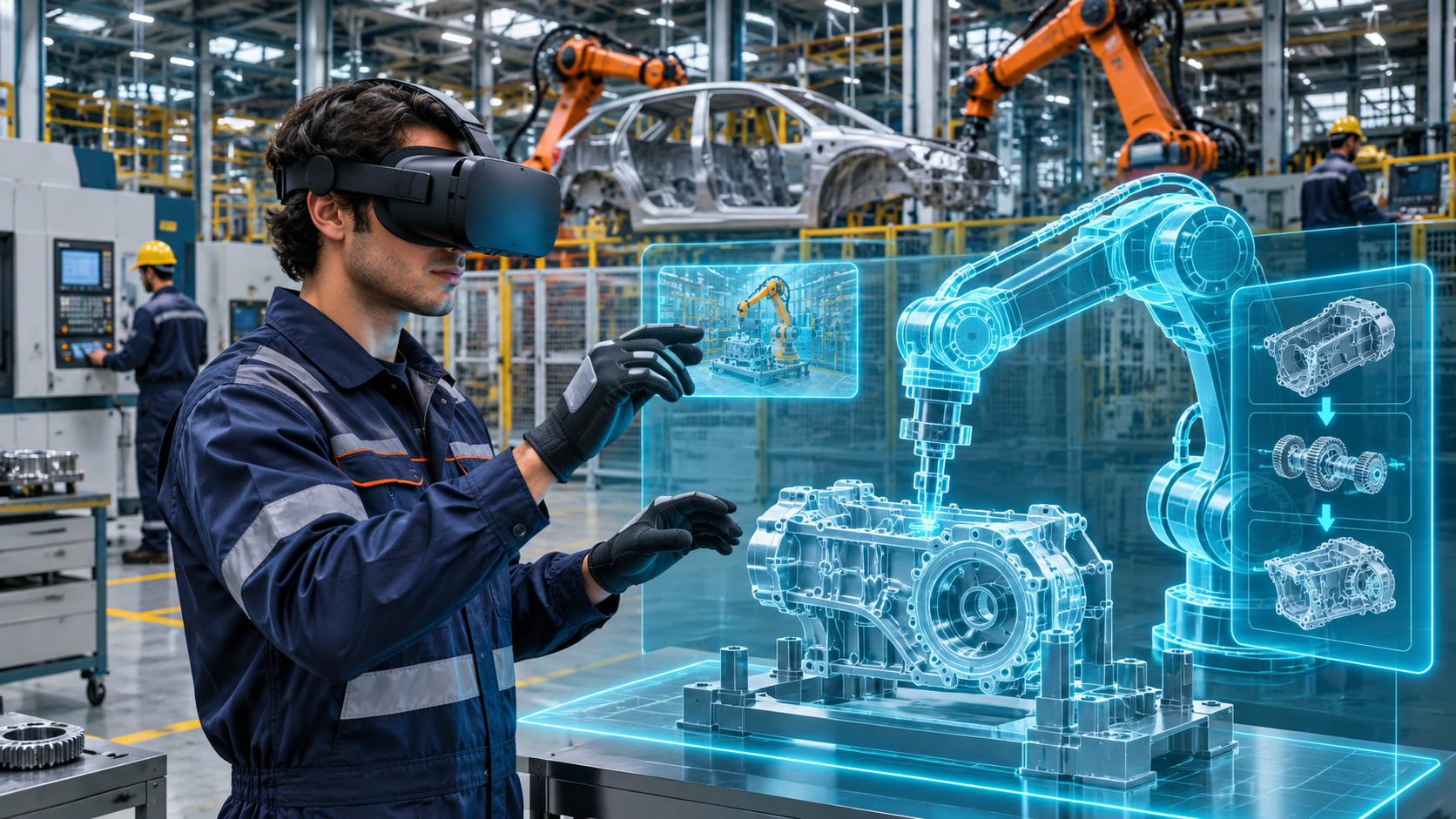
Understanding Manufacturing Operations Through Virtual Environments
A manufacturing facility involves several interconnected activities, from equipment setup and material handling to assembly, inspection and maintenance. Employees need to understand how individual tasks fit into larger production workflows.
VR training can recreate these working environments as interactive virtual spaces.
Instead of relying entirely on videos or demonstrations, employees can enter a simulated production environment, explore equipment and perform specific tasks. They can become familiar with machine components, understand operating sequences and practise procedures through guided interactions.
For example, a virtual manufacturing workstation can recreate an assembly process where employees identify components, select the required tools and follow the correct installation sequence. The simulation can provide instructions and feedback based on their actions.
This allows employees to become familiar with a process before performing it in an actual production environment.
Where VR Training Can Support Manufacturing Workforces
The application of VR in manufacturing extends beyond general employee orientation. It can support different operational activities depending on the equipment, processes and training objectives involved.
1. Assembly Line Training
Assembly operations often involve repetitive tasks that require accuracy, coordination and adherence to specific procedures.
VR simulations can recreate assembly workstations where employees practise component identification, positioning, fitting and installation. Interactive instructions can guide them through each stage of the process.
These simulations can also introduce different product configurations and assembly sequences, helping employees understand variations in manufacturing workflows.
2. Industrial Machinery and Equipment Operation
Operating industrial machinery requires employees to understand equipment controls, operating procedures and safety requirements.
VR-based equipment training can recreate machines such as CNC equipment, presses, cranes and other industrial machinery.
Employees can interact with virtual controls, practise operating sequences and understand machine responses in a simulated environment. Training scenarios can also introduce different operating conditions to help employees become familiar with equipment-related situations.
3. Equipment Maintenance and Inspection
Maintenance personnel need to understand equipment structures, inspection points and servicing procedures.
Through interactive 3D environments, VR applications can recreate machinery with detailed components that employees can examine and interact with.
Training modules can guide employees through inspection sequences, component identification, troubleshooting procedures and maintenance activities.
This is particularly useful when employees need to become familiar with complex equipment or procedures before working on actual machinery.
4. Workplace Safety and Hazard Awareness
Manufacturing facilities involve various workplace risks, including moving machinery, electrical systems, chemical handling and equipment-related hazards.
VR simulations can recreate these situations in a controlled environment, allowing employees to practise identifying hazards and following the correct safety procedures.
Training scenarios can include:
- Machine safety and hazard identification.
- Lockout/Tagout (LOTO) procedures.
- Fire extinguisher operation and emergency response.
- Chemical handling and hazardous spill response.
- Confined space safety.
- Working at heights and equipment-related risks.
- Emergency evacuation procedures.
Employees can experience different scenarios, make decisions and understand the consequences of their actions without exposing themselves to actual workplace hazards during the simulation.
5. Material Handling and Warehouse Operations
Material movement is an important part of manufacturing operations. Employees responsible for handling materials need to understand equipment operation, movement procedures and workplace safety.
VR training can recreate warehouse environments, loading areas and material handling activities. Employees can practise forklift operation, material movement, storage procedures and equipment handling through interactive simulations.
Moving from Demonstrations to Active Participation
One of the important differences between conventional training content and VR-based training is the level of employee participation.
A video can demonstrate how to operate a machine, but an interactive simulation can allow employees to perform the steps themselves.
For manufacturing organizations, this distinction creates opportunities to develop training experiences around actual workplace activities.
A customized VR training application can incorporate:
Interactive 3D equipment: Detailed virtual representations of machinery, tools and components that employees can examine and operate.
Guided operational procedures: Step-by-step instructions that help employees understand specific tasks and workflows.
Scenario-based training: Simulated situations involving equipment conditions, production activities and workplace hazards.
Task-based assessments: Activities designed to evaluate procedural accuracy, task completion and employee responses.
Performance tracking: Training records, assessment scores and progress information that help organizations monitor employee participation and identify areas requiring further practice.
These capabilities can be combined based on the specific objectives of each training program
Why Manufacturing Training Needs to Be Customized
Not every manufacturing facility operates in the same way. Different organizations use different machinery, production processes, safety procedures and equipment configurations.
A generic training application may introduce employees to basic concepts, but it may not accurately reflect the working conditions of a particular facility.
This is why customized VR industrial training is important.
Training applications can be developed using equipment references, operating manuals, standard operating procedures (SOPs), technical documentation and other materials provided by the organization.
The virtual environment can then be designed around the actual equipment, employee responsibilities and operational workflows.
For example, a company operating specialized machinery may require a simulation that recreates its machine controls, operating sequence and safety requirements. Another organization may need an assembly training application based on its product components and production process.
By developing simulations around these specific requirements, organizations can create training experiences that are more closely aligned with their actual operations.
How DevDen Develops VR Industrial Training Applications
DevDen develops customized VR training applications for manufacturing, industrial operations, equipment handling and workplace safety.
Our development approach combines realistic 3D environments, interactive equipment and scenario-based simulations to create training experiences based on specific organizational requirements.
Depending on the project scope, our VR training applications can include:
- Customized industrial environments and 3D equipment models.
- Interactive machinery and equipment controls.
- Manufacturing and assembly workflow simulations.
- Equipment operation and maintenance procedures.
- HSE and emergency response scenarios.
- Guided instructions and task-based assessments.
- Performance tracking and training reports.
Each application can be developed around the client’s equipment, workflows, operational conditions and training objectives.
From assembly line training and industrial machinery operation to equipment maintenance and workplace safety, we work with organizations to develop VR experiences that address their specific workforce training needs.
Planning to introduce VR into your manufacturing training programs? Contact DevDen Creative Solutions to discuss your requirements and explore the possibilities of developing a customized VR industrial training application.
